Tuesday, 17 July 2012

Banglar thhek...

“Bangalira thhek-ei sekhe”. True. Thhek/Adda or whatever you call it, imparts life’s greatest lessons on a Bong. To add to the above statement, “thhek ta jodi hoy maaler, tahole to kothai nei”…Hence this post. About “Bangalider banglar thhek”.
      
1.      Broadway Hotel: The day I heard about it, my first impression was “Hotel?? Decent na toh?” (I guess the term ‘hotel’ added to its name, makes one raise an eyebrow). And then one day, for a colleague’s farewell ‘thhek’, we chose Broadway. Standing in the heart of the office-para with Dalhousie Square at a stone-throw, the exact location is bang opposite Chandni Chowk Metro Station, behind Air India’s main office.
Huge yellow shuttered windows (‘Charulata’-style) are guarded with soot-laden screens. Long ceiling fans hang from soaring ceilings and their whining sound dull the busy honking exteriors of Ganesh Chandra Avenue. The walls are paneled in primordial dark wood. Cherry-red leatherette wooden chairs circle the old wooden table tops. The waiters have “matching” burgundy coloured outfits, except the chairs have more polish. However in places, the leather has worn out from them with sponge peeping their ways through.
The dull yellow walls, the oversized ceiling fans of East-India Company finish, the faded wooden exteriors gave me one impression, the last and the first. It’s the Coffee House for drinkers. It would not remind you of any faded grandeur; it will give you the feeling that it was like this for ages and there lies its grandeur.
 What classes Broadway apart is its choice of snacks. Alcohol makes you fat but the embellishments add to it. Broadway serves cucumber instead of peanuts and Bhujia (jhuri-bhaja). Chilled cucumber, sliced longitudinally into four with sprinkled black salt. Try it! Pure awesomeness.

2.      Blue and Beyond: Personally, my favourite drinking joint. It’s like, both Oly and this one were contenders and Oly lost one point for neatness. That way.
The roof-top bar-cum-restaurant of Hotel Lindsay stands tall on Lindsay Street, opposite Hogg Market (New Market).  No name could do more justice to it. Set on the 9th floor of the building, the view is breathtakingly beautiful. A picture of old Kolkata at its best. (Try the sunset) A bird’s eye view of the entire New Market, Corporation office along with Shahid Minar, High Court, Howrah Bridge, Statesman House, Birla Building, Indian Railway Office on one hand and Sudder Street, Ripon Street, a slice of Park Street on the other. The first time I saw my city from Blue and Beyond…the experience was of a thousand goose-bumps …totally.
There’s nothing to talk about the booze or the food, it’s just the over-all experience which snatches away the top position. I have been to B&B 180 times (plus-minus 5). On my first time, a senior in office was concerned and warned me, “It’s a Hotel. Men get girls drunk and then take them to a room. Be careful with whom you go”. “I am going with the gentleman I sleep with, everyday. I don’t mind sleeping with him one more time!” was my instant reply.
It’s infested with firangs and people assume that they pick up girls and use the Hotel for ‘ding-dong’ business. (The better-half says, “What Foreigners? Dekh bideshe ricksha chalay!”)
It’s true that these firangs often make passes at girls. It is the only place in the world where a man made a pass at me. And it added to the reasons why B&B is perceived with such great reverence. Had it not been for B&B, I would have never known my entire life, how to deal with such a situation.
Don’t be scandalised. If you haven’t visited B&B. you’ve missed a part of this city.
  
3.    Oly-pub: Technically the Olympia Bar & Restaurant (Daaknam: “Oly”) is considered one of the foremost watering holes of Calcutta. It’s not a hip place by any stretch of imagination and light-years away from being called a “pub”. But it oozes oomph like none other. Nested in the food-capital of the city, Park Street, it is the perfect destination to get real value for your hard-earned money (‘rokto-jol-kora rojgaar’), the greatest place to unwind for office-goers, students, first time drinkers, race-course bookies, poets, film critics, Ad-men, journalists and the like. It is said that Oly has been the breeding ground for some of the greatest poetries, films scripts and advertisements that Calcutta has seen. [Reminds me of the most common phrase at Oly: “Tumi ki koro bhai?” Answer: “Ami Creative”.]
Oly is without restrictions (except that the ground floor is only for men). You can sit there for hours, talk loudly, share seats with strangers and befriend them, not feel embarrassed even when the smoking section is positioned right next to the Ladies washroom and everytime you come across some ‘toilet-jokes’ shared by middle-aged men. If you are sharing a table with strangers, they will not ask you for your name, where you work or stay and how much is your ‘take-home’. You will bond on the basis of “Feluda, Neruda and Derrida”.
For the food. If Peter Cat stands for Chelo Kebab, Oly is synonymous with Beef Steak with pepper sauce. If you haven’t visited Oly, it’s an offence, but you have visited and not had their beef steak, it’s non-bailable. The other taste-bud-tickling items on the menu are Mixed Grill, Chicken ala-kiev, Chicken ala-oly, pork chops and ‘dalmut’ (the last one comes free with the alcohol). The French fries are delicious and it’s fun to share them with the friendly mice/rats when they pass below your tables occasionally.
For the alcohol. It is THE most generous alcohol joint in Kolkata. Not only in terms of price but in terms of the waiters (read angels) and their service. Pegs are measured religiously right infront of your eyes with a peg measurer as the waiter lets it spill over with your poison while being poured into the glass.
In addition, what sets Oly apart, is its non-pretence, earthy, no-frills approach. Check their ice-buckets! They are large, stainless steel made!! Oly is the perfect example of ‘All that is gold, does not always glitter’.

4.      New Cathay: It is surely not one of those places where you take a woman. It is typically a bar for office-goers, stags, college kids who have bunked college. I am being told by a Man, that New Cathay’s popularity reached such heights due to its close proximity to Regal, Elite, Society and Tiger. During their college days, men would head there for cheap booze after watching X-rated movies in the above theatres. Situated below the Grand Hotel on Chowringhee Road, it is a place which most will label as rowdy. ...filled with men who have X-Ray eyes.
But there’s a reason why it finds a place in my list. It is THE place where I first drank publicly. With college friends. We had to drink (for most, it was the first time) and New Cathay was the cheapest of them all. In addition, every place has its own specialties. Their liver curry and the fish-snacks are truly authentic and rare too. Also, the Nehru-cap clad waiters. Hard to find nowadays.
Rare also reminds me that they have live music! Live music, that lacks sophistication (unlike Someplace Else) and is way below Trinca’s standards. A little sleazy. But I loved it. Just like Old Monk never loses its charm in the midst of Jonnie Walkers. Like that.

5.      China Town: Situate in the eastern corner of Kolkata, on your way towards the Science City, is the China Town. Aroma of authentic Chinese food combined with the obnoxious stink of tanneries. That’s China Town/Tangra for you. Other than food and awesome quantities of it, you get booze in an amazing fashion. You can buy bottles instead of pegs. In any modest bar, a peg of an Antiquity or Royal Stag would cost you 150 bucks. Just imagine having/sharing 12 pegs. A flat 1800. On the other hand, here, you are given a bottle for 900 bucks. Those same 12 pegs for half the price! Isn’t that cool?    
There are more than 50 Chinese restaurants in China Town, the top picks being, Hot Wok, Beijing, Big Boss, Canton and Kim Ling. Most of them provide you separate rooms (for 15/20/30 people) if you are throwing private booze-parties.


6.      Shaw’s: Also known as Chhota Bristol and placed at one end of Metro-gali (off Lenin Sarani) the Shaw’s Bar does not encourage women, tyaansh pub-hoppers or snooty executives. In an age where drinking is often associated with sleaze and flesh trade, this bar claims to have kept its image Nirma-clean. The most humble of the bars discussed here, where tipplers share narrow benches (like tea-stalls) and hawkers hover around the tables ferrying snacks. Snacks include sliced ginger, aloo kabli, ghugni and chops. Oh yes, you cannot reserve a table here exclusively for yourself!!
Prices of alcohol are significantly low with an electric board displaying prices of brands on offer with relentless monotony. You have to pay for each peg as soon as they arrive your table, eradicating the chances for potential trouble-making once you are drunk.
I have heard that Ritwik Ghatak was a faithful patron. He would land at Chhota Bristol, whenever he was short of funds or was dissatisfied with a script.  
I have also heard that Shaw’s used to serve alcohol in earthen pots (“bhanr”). But am sure it’s a rumour. For that raw tipsiness, please visit.
******************************************
     There are so many more. Someplace Else and Trincas are perceived by me with great admiration. However their failure to bag positions in this list, is because of the music. Wonderful to listen to, but unfit for addas, loud cheers and clatters, enthusiastic debates, inhibition-less laughter and fights.
      And, there are many more. Like Abcos, Triptis (my man affectionately call it ‘Strip-tease’ for reasons best known to him), Green Palace etc etc. Some other time, may be. 
     Till then, Cheers!!
******************************************
Photo courtesy: Internet

Wednesday, 4 July 2012

Bong-ness...

As if enough has not been written already?
Nonetheless, this is an endless list. If we could brace ourselves and compile them in their entirety, we could put Rajnikant and the Sardars to shame.  However, this post is not about Bong-jokes. It’s about the words and phrases Bongs use here there everywhere, everyday. I think, there are things beyond “thanda lege jabe” or “chule keokarpin laga” which a Bong can be identified with. Our colloquial expressions have changed with time with a few expressions like “Boroline lagie ne”, “ki gorom poreche” and “Puri ghure ashi” finding their places in the Hall of Fame. But there is much beyond and here are some of my favourites:
1.   “Chap nish na”: (Take a chill pill): In the Bong dictionary of ‘most used terms’, this phrase ranks No. 1. With a Bong’s reputation of not finishing things on time, these words of assurance work like P.C. Sircar’s magic. There was a time when it was used only among ‘wong’ men, but its rising significance has bagged it a place in the Bong vocabulary of all ages, irrespective of sexes.  When followed by words like ‘Boss’ and ‘Guru’, this phrase reaches a different level altogether.

2.   “Lyath khachhi”: (I am lazing) : I asked a friend last Sunday, “Ki kheli dupure e?” (‘What did you have for lunch’). And her answer was “mutton and lyath”. A distorted version of “lethargy”, this term is perceived by Bongs with great reverence and admiration. It is a way of life and has risen to such standards that it is compared to food! After t-shirts reading “I love NY” or “I love Pranab Mukherjee”, it would be great to have some with “I love Lyath” scripted on them.


3.   “Ekta Jokes sunbi?” (Wanna hear one jokes?): The word “jokes” like ‘trousers’ is only used in plural when used by a Bong.


4.    “Ekta cold-drinks de to”: (Give me one cold-drinks): The other word apart from “jokes” which is used in plurals in all its manifestations.

5.   “Chol, maal khai!”: (Lets drink): The phrase itself makes you high, have you noticed? It is one solution for every occasion.


“Promotion hoeche/ maine bereche”.. (I have been promoted)
Reply: “chol maal khai”.

“O hya bole dieche” (She has said yes)…
Reply: “chol maal khai”.

“bou baaper bari geche”.. (My Mrs. has gone to her parents’ place)
Reply: “chol maal khai”.

“bou divorce debe boleche”… (My Mrs. has threatened divorce)
Reply: “chol maal khai”.

“bou divorce diechhe”.. (My Mrs. has become Miss)
Reply: “chol maal khai”.

6.   “Khawa!” (Give a treat): Just replace the replies in the paragraph above. Period.

7.   “Refuse korlen je? Number ta tookey police ke debo?”:  A Taxi in Kolkata is known for its high rate of refusal. If you stay in the outskirts of the city, like Behala, Budge Budge or Belghoria, taxi-drivers would make it look “Ki? Mars e thaken?” (You stay in Mars?). They know of three places (and ONLY three places): Airport, Howrah Station and Sector V. That’s it.

     In order to counter such misdemeanor, Bongs threaten that their registration numbers would be taken down and reported to the police. You get to hear this one phrase atleast 350 times a day out of which none gets lodged ultimately. ;) 
8.   “Bie-barir presentation kena hoeche?” (Have you bought gifts for the wedding?): If you are not recycling some tea-set, bed cover or an old Shawl, you have to buy a gift. And yes, you read that right. Gifts and presents are conveniently called‘presentation’! What kind?? Slide-shows? Powerpoint? Excel? LOL.

9.    Bibhotsho/ Jata/ Byapok: Words of ecstasy. Words of immense acclamation.  Bibhotsho literally means gruesome and jata means awful. However, Bongs have chosen using same words for diametrically opposite connotations.
Examples: “Ki bibhotsho gorom poreche!” (awful heat) as well as “Ki bibhotsho cinema banieche Srijit!” (awesome movie).
“Question paper ta ki jata set koreche mairi“ (awful question paper) as well as “jata namie dili to onsite project ta!!” (awesome job done).

‘Byapok’ does not have such nuances but its use is extensive. “Byapok mutton”, “byapok meye”, “byapok jayga” are some of the many.

10.  "Marketing korte jachhi": (We are going shopping): When uttered these three words, my husband’s instant reaction is “Marketing is something we do 13 hours a day in the office. For the sake of Gandhiji’s blessings. What you are doing is SHOPPING. And NOT Marketing (making it sound heinous). Please amend”. But we Bongs never make changes. Gariahat and New Market are all about marketing, right? (‘Poojor marketing’, ‘Bier marketing’ to name a few)?

11.  "Miss call dish" (Give a missed call): It is not a typo. We actually say MISS-call. Of the funny things we do with a mobile phone, (like treating it like a walky-talky, bringing it onto the mouth while talking), giving miss-calls is one of the many. We have a miss-call solution for everything. A signal for “I have reached”, an affirmation for ‘the movie tomorrow’, an indicator from the driver that he has reached your office parking, miss-calls are boundlessly useful.


12.  "Phone e balance nei" (There’s no talk-time in my phone): Inspite of surviving on missed calls, a Bong always runs out of balance. Always.

13.  "Ilish koto jachhe?" (How much is the price of Hilsa?) ‘Ilish koto jachhe’ is phenomenal. Just like “Sensex koto jache?” It’s true that a Bong is more concerned with the price index of Hilsa rather than of gold and stocks. Bongs make a comparative analysis of prices of fish (mainly this one) from various local markets and buy the best. A Bengali man’s claim to fame is through his efficiency in choosing the right fish and is considered at par with singing Rabindrasangeet by a Bengali woman. A Bong can even drive his way to Kolaghat from Kakurgachi for that one silver vertebrate. To add, you are not considered a Bong enough, if you buy fish from Spencer’s, Food Bazar or other retail outlets. It has to be from the local market after a detailed sensory perusal.


14.  "Anondobajar ki bolche?" (What are the views of Anandabazar?) Their ‘porte hoy, noile pichhie porte hoy’ campaign has affected the Bongs like no other. Reading Anandabajar is reading Gita/Quran/Bible. For the fear of ‘jodi pichhie jai r daak sune keu na ashe’ we often substitute our views with theirs. The invariable sign of a Bong-antel, Anondobajar is.

      My cousin who stays in Gurgaon, while asking about the reviews of a recent Bengali film, asked the same....”Anondobajar ki bolche?”. Sarcasm apart, such biblical is its status. Considered to be the most unbiased (barring Sourav Ganguly), this newspaper has a view about everything, above everyone else in the business. Dada, Didi, Pranab Babu, Prosenjit, Pinky Pramanik, Prince Charles, Leander Paes, Sunny Leone, fatherhood of Aishwarya’s baby…name one and you get all. (Achha, you can bunk the fatherhood part, ok?)

15.  Baal (some words are not meant for translations and for moms to read): I had read one SMS which had a detailed analysis on this widely used Bong term and its paisa-woosoolness. This term can be used as a noun, pronoun, verb, adverb, adjective, signs of frustration, happiness, despair, joy and the like. The commonest of them being:
·    Common Noun: ‘Tui ekta mosto boro baal’ (You are a good for nothing of   the highest order)
·    Proper noun: ‘Ki politics korte parish mairi. Tor naam ki Baal Thakre?’  (You are so good at politics. Is your name Baal Thakre?)
·    Adjective: ‘Baaler chakri sala’ (This job sucks!!)
·    Adverb: ‘Baal khello team ta. Go haran harlam.’ (Poorly played. We lost the game).
·    Frustration: ‘Dhhur Baal!’ (Sh*@!/ F*#@)
And the list grows happily ever after…


So, here were some randomly chosen, dearly loved and often heard Bong expressions/ mannerisms. “Case kheyeche”, “Pujoy south ta korbo”, “Suppose, dhor..”, “Dettol lagie de” (while putting Savlon), “Phatiye diecho ostad”, “Jhaari marishna”, “Apnar gari mileage koto dichhe?”, “Didi koddin tikbe?” are some more.
With Flipkart’s wide publicity during the IPL and when praised ceaselessly of its pocket-friendliness, my father’s observation: “eta ki College Street er cheyeo sosta?” (Is it cheaper than College Street?) This is one Bong statement. A Bong cannot imagine books cheaper anywhere else other than College Street. Bongs make lists of their favourite books from the Bookfair and then take the same lists to their favourite book seller in College Street and Bingo!! 

I heard something like this yesterday. “Uff ki figure!!..... Ami eager!!” (of course, not indicated at me).
No one beats a Bong in his wise-cracks. No one.

Wednesday, 27 June 2012

All my tea…

A major part of childhood was spent with my maternal grandparents. Thanks to the two months long vacations every year, Ma undergoing a surgery and a second pregnancy. For most children, dadu-bari (nana-bari) is a place of unadulterated and endless mollycoddling. No exceptions here.
Like all Bengali households, there would be several tea sessions with friends and relatives and I would consistently insist in carrying empty cups to the washbasin once tea was over and guests were gone. (Yes. Grandparents valued granddaughter’s pleadings more than bone-china cup sets). I remember this one clearly, even though I was barely 6 or 7 then. I will explain. Once tea was over, I would peep into the empty cups. Well, the almost–empty cups. You must have noticed that people drink tea and leave the last sip in the cup itself (why??). Sometimes it would be a few drops, sometimes a gulp. But it would be there…always, unfailingly. And I would look here and there, see if anyone’s noticing and drink that leftover. Leftover tea from cups often used by almost-strangers. That was fun! (20 times more than the first taste of alcohol or the first ring of a cigarette, I tell you). Tea was a forbidden territory for children of my age and drinking ‘eyto’ (ort) was a sin then, now and for all times. If Ma reads this, she would want to wash my whole system RIGHT NOW with DETTOL.
And that was the beginning of an unfaltering love story. With tea. A staunch tea addict that I am, “cha-hunga mein tujhe sham savere” continues to be my national anthem. Pardon me for the horrible joke and lets get down to the real point.
It is said that no one knows their cup of tea better than a Calcuttan. Well, tell me one thing the Calcuttans are not best at!! (dripping sarcasm).  I quite agree however to the tea part. With the city’s close proximity to Darjeeling and Assam, it is quite understandable, no? Being a hopeless aficionado, I choose to babble about my favourite flavours and aromas and not exactly baato gyaan on tea, tea-testing, tea-tasting and other platonic stuff.
I love milk tea. Period. And “office-para footpath tea” tops the chart. It’s not the milk that you put in the tea. It’s the tea that you put in the milk that makes it blissful. Staunch Darjeeling tea-fans would stop reading the post right now. Well, please excuse me then. I am a roadside tea fanatic. Milk, sugar and water mixed in the right proportion and tea added once in a while. I said “once in a while”, because they recycle the same tea atleast 50 times in the day. They don’t use strainers, they use old cloth. Squeeze out the last brown drop (like ICICI loan-recovery team) and again put the same chai-patta into the tumbler and make it boil. And yet, you would sit on those half-broken wooden benches and enjoy your cups (read ‘bhhanr’) with delight. The terracotta cups in which tea is served has a thin film of dry earth which gets combined with the tea and so does the smell of the kerosene stove. What makes office-para tea so heavenly is those glass jars filled with One-Rupee bakery biscuits (which Calcuttans affectionately refer to as biskoot) and Barua Bakery cakes (also called tiffin-cakes). The fun is, you can open the bottles on your own without the tea-seller’s permission, take out biscuits of your choice, dip them and eat. Oh yes, drinking tea from these stalls and not dip the biscuits in the tea is a crime.

Once in a while, depending on bad moods, headaches and work pressure, you ask the tea-seller to add a pinch of ginger or cardamom into the tea to make it stronger. The aroma is orgasmic.  
The tea stalls are humble, often based under a plastic canopy to ward of elements and crow-blessings. It would invariably have an owner who would sit the whole day making tea and a below-14-years-old-Chotu to carry tea to various offices. He would also fit in a Ram-Sita or Hanumanji picture and an agarbati with obnoxious smell. A radio unknowingly attracts more customers, but as I said, he is oblivious of such marketing stunts.

Office-area tea is also served in these white bone-china cups. People whose sole source of sustenance in office para is tea (accompanied by quarter pound breads), know the subtle difference between ‘bhharer cha’ and tea served in these white cups. This is the more sophisticated kind, a little more expensive (5 rupees instead of 3) and is served on bone-china plates. In a hurry, office-goers pour their tea in those plates and drink it directly therefrom. And the ‘slurp’ sound!! A very common sight in Dalhousie, High Court area and Deckers Lane, agree?

It would be immoral not to mention the quarter pound breads here. As Bongs say it ‘Cha–er sathe Ta’ is a must. In moments of leisure (which Bongs have in plenty), one rupee biscuits are replaced by breads, buttered or jammed. People don’t spare these breads from dipping into the tea, as well. (Replace ‘people’ with a first person, singular number ;))
Since I am talking about tea from the office localities, I might as well mention quickly about the tea served from vending machines in our respective offices. I love the froth, the creamy effect and the cardamom and elaichi flavours. Froth reminds me, when you gulp office tea, you have moustaches!! Tea-lovers get perennially pissed off with such tea. Great glory is attached to coffee from vending machines while foamy tea is looked down upon with utmost disgust. I choose to take its side. Selflessly.
The same taste of mota-cha can be enjoyed in trains and railway platforms, na?

That’s Assam Tea for you. Sinewy, robust and conventional…with milk and sugar. What is a downpour without such tea and pakoras? Its light bodied Darjeeling brethren does not match its standards when you are sitting on your window sill and enjoying the pitter-patter…atleast for the first person, singular number I referred to. :)
And for recommendations. As a good Samaritan it is my duty to enlighten you about one or two favourite tea joints in Kolkata. The twin tea joints of Sharma and Balwant Singh beside the Harish Mukherjee Road Gurudwara (near Elgin Road crossing). Well, I made up that ‘twin’ part. They are very close to each other, almost on each other’s sides, I stand corrected. Sharma Tea Shop serves the typically thick Assam tea and I would recommend a breakfast to follow. Kachuri with dal, alu-sabzi and hot gulabjamun is sinfully mouthwatering. Try it. Same for Balwant Singh Dhaba. Other than their “world-famous in Calcutta” Doodh-Cola in plastic jugs, they also serve amazing tea. You would gladly part away with 10 bucks for a cup, once you’ve tasted it.
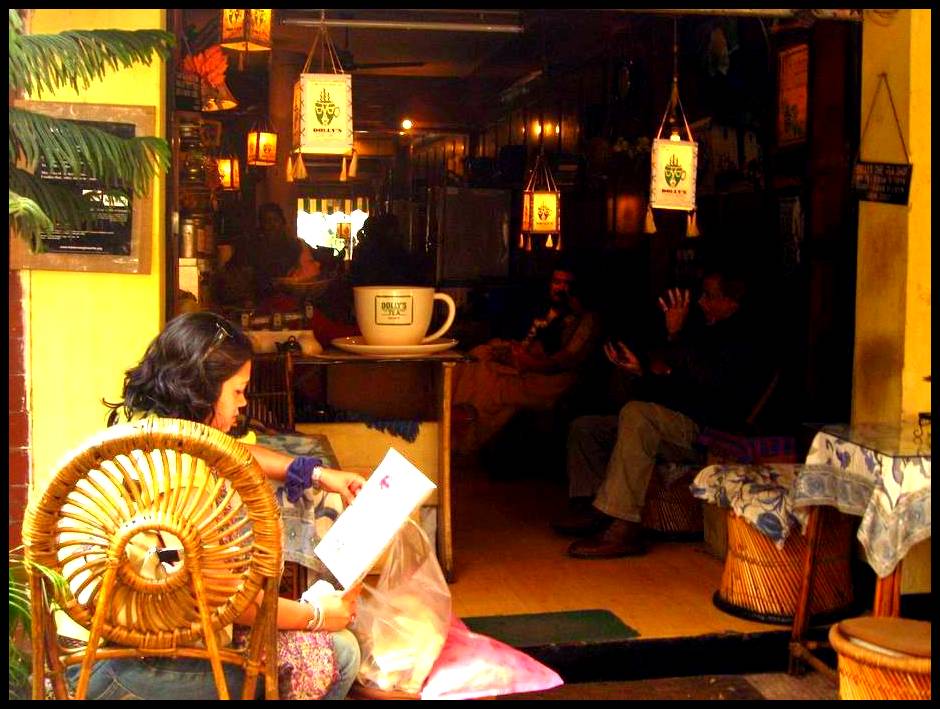
The second joint is Dolly’s. Tucked in one corner of Dakshinapon Shopping Complex in South Kolkata it is THE perfect place for aficionados like us (and chatterboxes too). You can finish one cup of tea in an hour. No time limit. It is infested with college students, lovers, antels (Bong intellectuals) and the like. It is tiny and cosy with walls paneled with old tea-chests. What marks it different from other tea-joints, is, it sells a huge variety of teas by kilos, ranging from a modest 400 rupees per kg to 10,000 rupees per kg. The other interesting part is that it is one of those rare places that serve these teas by a small cup allowing you to play a tea-tester/taster and convince yourself with your purchase. Try the Makaibari Oolong, Darjeeling Autumn, Makaibari Silvertips. Oolong is treated with great reverence for its aroma and it is considered a crime to put add milk and sugar in it. Darjeeling teas, fail to excite me so for me, Dolly’s is all about iced tea and their endless variety. Iced tea with a scoop of icecream, orange, watermelon, peach flavoured iced teas are considered juvenile but that’s my kind of poison.

Back to the pavement story, the roadside tea-sellers not only sell their tea for a minuscule 3 rupees, but the glasses, as well. So you get a full set for merely eighteen bucks. I tell you, keep such a set at home. On days of downpours and addas, use this set instead of an expensive Luminarc or Correlle one. And for the tea, get one of those quirky painted kettles. (I will tell you where to get it, unless you paint it yourself). This accentuated with pakoras (read ‘telebhaja’) makes the whole experience magical.
I am being told, “Avoid milk tea. It’s fattening”. Well, all good things are. Chocolates, S**, Alcohol. Do I need to bother? Mallika Sherawat does not have my brains; I might as well spare her a good figure. Hmm?
 
[photo sources: mostly internet]

Wednesday, 20 June 2012

Train-ed

Time is money. So is your job. With both to maintain, travelling had to be made less time consuming. We tailor our itineraries in a way that the distance between two cities in opposite hemispheres of the country is traversed in lesser time than it takes from Behala to Barrackpore or Colaba to Kandivilli. In the last one year, all I can think of is, two train journeys…compared to innumerable aeroplane rides I had. Two hours flight replaced by 2 whole days in the train is unthinkable. However, Mr. Perfectly Alright and I are ceaselessly in love with train journeys and sometimes make it a point we travel by train. Needless to say, the excitement in travelling by a train is incomparable with any other journey (I haven’t tried space-ships though).

The thrill begins when you have a Waiting list or an RAC ticket. Every now and then you track it, with the anticipation that someone’s tickets are cancelled to give way to yours. You apply all your means, connections and bribes to get the tickets done. Especially, for Bengalis, travelling is like politics, adda and Uttam Kumar. Imbibed in their neurons. Life without travelling is equivalent to no life at all. (You see tourists dying in bomb-blasts in Kashmir or land-slides in Kumayun. All of them are Bengalis).

And once your ticket is confirmed, starts the real fun. Packing! There is no 20 kilos weight limit. You can almost carry your 800 sq.ft. home into the train with slight variations. Safety-pins, idols of Ram-Sita, gas burners, packets of puffed rice and Maggi, pickles, blankets, radio sets, pets (non-barking ones) and a range of other useless and useful things tuck themselves conveniently in those huge metal trunks and trolleys (read ‘suitcase’). In the event they cannot tuck themselves so conveniently, children would be asked to sit on the upper-lid, so that the luggage can be closed properly and locked tightly. And, if there is a numeric lock, then each time the luggage is opened (or closed), the person turns a Vinay Pathak in Bheja Fry! (You know what I mean).

One thing I fail to notice nowadays, which was very common when we were small. The owner of the luggage would have stickers bearing his/her initials fixed on the suitcase on two sides of the handle (there was a specific space for doing it). In yester years, suitcases used to come with alphabet-stickers. You choose your initials, stick them and when the luggage is lost, the whole world would come to know that it belonged to you by a mere B.G, C.N or   S.P (as if)!!!!

Once things are packed, starts the first round of counting the luggage while putting them in the boot of a taxi (fondly called “dicky”) and then see for the umpteenth time whether the cab-driver has locked it properly. On the way to the station, at every red signal where the taxi has stopped, check whether the dicky is still locked. The second round of counting starts after reaching the station. The third round follows while handing over the luggage to the Coolie and the final one once you’ve boarded the train. The in-between mental counting goes on while following the Coolie till the train. And of course, keeping a count equally applies to little children, if you are travelling with a number of them (except the dicky and the coolie-part, of course).

For Bongs in Kolkata, like us, I think you would agree, the delight of travelling begins at the very step onto the Howrah Bridge. It is like a lovely trailor to a lovelier movie that lies ahead (unlike the present Yash-Chopra movies). The thrill, the excitement and the boundless joy begins just at the visibility of Ganga, the mightiness of the suspension bridge and the Howrah Station that beckons. And then, the sight, smell and sound of the station make you ecstatic..instantly. You don’t mind the sweat, the loud bustle, the annoying pleadings of hawkers and the relentless bargaining sessions with Coolies.

One more thing I have noticed. Whenever we used to travel in big groups, people would join each other near the “Boro-ghori” (the big clock) in Howrah Station. This was one unfailing landmark for all, I guess. Not only for travellers, it is the greatest rendezvous point for lovers, friends, relatives as well, before they take their respective trains. In the age of no-mobile phones, people who got lost in the railway station, would invariably wait near the “boro-ghori” with the anticipation that their friends or relatives would come here atleast once to look for them. I have heard, office-goers check if their wristwatches match the hands of the big clock during ‘awpish’-time.

And then starts the advent towards the train once the platform is declared. Checking names on passengers’ list (complaining “hey I am 36 years only, they have written 40 against my name”), pushing way thorough mounds of luggage, passengers and porters, dealing with the one who carried yours and ending the bargain with likes of “tang maat karo, tang maat karo, kafi ho gaya, zyada ho giya..” (in sonar kella-style). Achha, have you noticed, we, Bongs always speak to Taxi-drivers and Coolies in Hindi? Why???

With luggage settled beneath your seats and fixed with chain locks available on platforms (as if all that you are carrying are gold biscuits), starts the good-bye session. There would be a throng of relatives, well-wishers, neighbours to see you off, and as Mr. Santosh Desai rightly pointed in one of his books, “waving goodbye till well, after your train had crossed into the next state”. How true!!! Not to miss the assorted advices that follow…that follow you, once the train is on the move. “Eat well”, “Don’t eat from the vendors in the train”, “Don’t accept any food from co-passengers” (with the anticipation that they may put sleeping drugs into your food and steal everything), “Don’t put your hand outside the window”, “Try not to poop in those dirty latrines”, “I pity your seat numbers are 1, 2, 3 and 4..they are so close to the entrance and the latrines. You won’t be able to sleep because of the noise and the smell”, “Don’t pull the chain by mistake” are some of them.  (I have heard that ‘don’t put your hands outside the window’ is such a ritualistic statement, that Bongs say it even when you are travelling in an AC coach or an airplane!!)

And now that your train has started, you have a mixed feeling of fear and frolic. You cross-check the tickets and in case you have a 15 years old Mumpi traveling with a 26 years old Sumana’s ticket (due to last moment plan-change), you teach her to settle in the upper berth as soon as the ticket-checker advents, so that he fails to fathom her exact age from a distance. 

The beginning of the journey is characterised by men putting their sneakers into their bags and pulling out from newspaper-wraps their rubber sandals (which we Bongs affectionately call Hawai-choti), taking off their trousers and slipping into a pair of shorts (also known as haap-paant) or lungi. Yes, Indian men often have a separate set of clothes, one for boarding the train and the other for travelling in it. It is then followed by expert comments regarding the cleanliness of the toilet and pleading co-passengers to use it to their heart’s content with the anticipation that the latrines would soon become soiled and unfit for human defecation.  

As the train moves on, crossing one state after the other, conversations with neighbouring passengers intensify. We soon get to know their whole itineraries including the money invested in the tour. Their aloo-parathas are exchanged with luchis during dinner and upper berths exchanged for lower ones, pleading arthritis (telephone numbers are exchanged too!). Swapping seats with friendly co-passengers is a widely accepted phenomenon. I remember, many years ago, while travelling from Chennai to Kolkata, a couple with 2 kids had waiting list tickets. (In Sleeper class, you are allowed only to board the train with such tickets but NOT to sit). My father had made me sleep with one kid while the other slept with my brother. My parents left their entire berth to the couple. The two sets of parents had kept awake the entire night sitting and talking to each other.   

And no journey however small or big, is complete without the mention of food. The moment one boards the train, I guess, the appetite multiplies infinitely. Tea is had at an interval of 10 minutes, followed by ‘coal-dinks’, jhaal-muri, roasted peanuts, pakora, cutlet and bread-omelette (the vendors have a peculiar way of saying it!). When we were small, the second meal in the train was always from the pantry (the first being home-food). And the enthusiasm of eating train-food was like having a lunch at a 5-star hotel and the excitement as great as turning 18. The pickle, the dahi, the almost-always-arhaar daal and the presence of 2 eggs in the egg-curry (when you had expected one) was heavenly, trust me. It was a feast for eyes and for the stomach.

Train food was punctuated with food from big junctions. Kharagpur signified puri and alu-sabzi (unskinned potatoes, i.e), Bhubaneshwar stood for sweets, bananas and filling of water-bottles, Vizag and Vijaywara for fruit juices, Nagpur for oranges. The stations in South India would invariably distinguish themselves with Vadas (which looked like doughnuts), Dosas, Curd Rice, Egg-Biriyani and onion-raita, all wrapped in Sal leaves.

Filling water bottles in railway stations reminds me how anxious we used to get at the thought that the train may start any moment and leave the station with Baba being stranded there forever. (To be honest, we, as kids secretly wanted this to happen atleast once, so that we could pull the chain. That would have been a lifetime experience).

Such simply exciting and excitingly simple were the train rides. In one of my Kolkata-to-Mumbai flights, at the time of getting down from the aircraft, my neighbour asked me “Mumbai?”  I felt like saying “No. Uzbekistan”. In the entire 2 and a half hours flight, I was feeling terribly bored and was waiting to talk to someone, while the man on my next seat had his eyes glued to an India Today. Now that the flight has come to an end, he finds the time to talk! Had it been a train journey, I would have made him play cards and/or antakshari with me, share his lunch and books and knew enough of him to write a short biography.  Exaggerations apart, what I mean to say is that the warmth and the joie de vivre a train journey offers are truly unmatched.

The last time I travelled in a train, I made it a point to collect as much memories I could. I had as much pantry-food as possible, IRCTC tea was had in abundance accompanied by bread-omelette, ludo bought and played but most importantly, soap papers bought in a bundle. This is one thing I miss so much. With the advent of wet wipes and hand sanitisers, that is. When we were kids, wedding feasts were followed by finger bowls (colourful plastic ones) with soap papers in each (instead of lemons, as it is today). And these soap papers were a MUST in train journeys as well.

Well, as I said, in our endeavours to maintain time and jobs, travelling cannot be made a prolonged affair. Flights have thus replaced train journeys in a major way. Simple ways of life has been swapped with faster and more refined ones. Nevertheless, for people like us, whose childhood memories are overflowing with moments spent in the train (sleeper class, to be noted), no journey can ever replace them in terms of the fun had. Hearts are trained that way!!

Sunday, 3 June 2012

Auto-mate-ic

No cheating. This is an old post, written almost a year back. Still. I want to show it off here (the second reason being, I AM quite a show-off!!). Months back, while walking down the erstwhile Great Eastern Hotel footpath (erstwhile, because the hotel is been renovated and reincarnated), I chanced upon a small roadside stall which sold everything for Rs.5/- . Amazed at the huge variety of stuff and the incredible customer-friendly price, I stood there for a while. Among safety pins, erasers, rubber bands and 50 other odd things, there was a plastic auto ricksaw. Very tiny, quirky and had a charm almost ten times as much as its size. And that cute little thing encouraged me with the post…a post about my favorite public transport on the Kolkata roads.
The foremost reason for re-posting (you already know the second reason) is, during the 70% sale at Mother Earth, I bought an amazing set of book-ends (worth 799 bucks) at an unforgettable 229 rupees. I was thrilled. Don’t be jealous, some people are born lucky ;)


By the way, here’s the old post in a new blog with a few edits, of course.
The reasons behind the unqualified love and affection for the vehicle are many and some of them are here:-

1.       For auto’s “janlar dhhar” (window seat). It is THE only public transport on the road which has such a cool window seat. I recollect, how on lazy days, I have refused 2-3 auto ricksaws just to get into the one with the coveted seat. No other window seat gives you a 66% body exposure and let you enjoy the breeze at an optimum level. (The last sentence totally sounded like “open the window and let atmosphere come in” but, could’nt come up with a better expression, seriously)…

2.       Point No. 1 was meant for the back seat. But I also love the window seats next to the driver’s, especially the one on his right. It remains the most undisturbed seat. No “didi-ektu-namun-to-ei-jonno-bolechilam-bhetore-boshun-ami-agey-nambo”-hindrances. Not that I blame them. They also belong to “love for point No.1 above” category. In recent times of CNG autos, the seat on the driver’s left remains equally peaceful. You don’t have to get down every time the auto stops and the driver pulls that weird rod below your seat unendingly to start the vehicle again. And of course, the seats next to the driver’s give you a 100% body exposure. (I know this sounds bhojpuri-english, but I still could’nt find a better expression).

3.       85% of autos have radios. Pure awesomeness. This is one of the foremost yardsticks by virtue of which auto emerges as a clear winner over ricksaws, trams, buses, taxis and share-cabs. I know we all have headphones. But the full-blast music, with dhinkchak purple-green-red tiny lights bordering the radio and the interiors remain unparallel entertainers. 
And, the autos perpetually play the radio station you generally like the least, playing songs with “uiamma uiamma” words, songs with double meanings and obscene lyrics or songs sung by Bappi Lahiri (refer to “chirodini tumi je amar, jooge jooge ami tomari...”). But, I don’t know why, I always end up enjoying the whole experience, just at the sight of the immense pleasure the auto-wala gets on hearing those songs.

4.       For the incessant dates we have had in autos. This was in Class 11-12, a decade back. On my way to tuitions, I used to meet him and was perennially gripped by this fear that someone may see us if we sat in a restaurant or a park. So there was this unwritten commandment (from my end, of course) that we would date mostly in the auto. Here too, the auto wins over buses for its “privacy” factor and taxis for the taxi’s “over-privacy” factor (you can have a single friendly co-passenger in an auto, but not in a Taxi!!!).
I remember our Taratolla to Deshapriyo Park auto rides (often to and fro), getting down from one auto and going into another and that’s it. A date consisting of 2-3 arbit auto-rides and bagful of memories.
By the way, on rainy days, auto-walas hang plastic curtains on the sides, as well. ;)

5.       Extreme pocket friendliness. I know many a times travelling the same distance by a bus and an auto costs you the same. When the minimum fare for both stands Rs.5/-, why take a bus? That also reminds me with petrol priced at Rs.78 a litre, very soon auto will rank first not only among my favourite public transports but among private ones as well.

6.       For the funny, heartwarming, insightful conversations I have often had with the auto drivers (Yes, I chat with them too). Whenever I get the front window seat, I invariably end up babbling with the auto-driver. It includes topics like football (where he talks and I listen), traffic jam, price-hike, movies (with special emphasis on Posenjit, Dev and Jeet from his end), his “chhele-meyer schooler tuition fees”, politics and the list goes on. Of course, the hottest topic being our lady CM (where we only talk and do not listen).

7.       The almost cent percent rate of non-refusal, unlike their notorious taxi-brethrens. To add to it, if you and the other 3 co-passengers are friends (preferably female) and you could nag him a little, the driver would even change his route and behave like a cabbie. I remember 3 of my friends and I had taken an auto from Park Circus. The last stop was Gariahat, as known to everyone who belong to the southern hemisphere of this city. However, we convinced him to take us to South City instead, at a meagre fare of Rs.10/- each. How terribly sweet was that!! On many Sundays, I have experienced the same good-Samaritan act (even alone… without female friends).

8.       For its nearly undefeatable way of sneaking past the buses, lorries, taxis and private vehicles at times of utmost urgency (read office-time). They are unparallel in taking short-cuts, taking wrong sides of the road and taking you to your desired destination almost on time.

9.       For the funny messages painted at the back of the auto. They are funny just for their simplicity. Statements like “manusher cheye chhagol dami”, “bhhara rakhun haater kachhe…somoy, jalani dui bache”, “shyekra ke rupo dilam payel kore dilo…driver ke gari dilam pagol kore dilo…”, “dekhle hobe khorcha ache”, “dekhbi r jolbi..luchir moto phoolbi” and the most common “najar lagale juta khabe” and a small rubber-sandal hanging next to it. They are often meaningless, often out of context, but they are still so much better than a bland “HORN OK TATA” or the clichéd “Mera Bharat Mahan”.

10.       On the way back home one day, an Auto-driver asked me “Khuki, kothay nambe?” ‘Khuki’ is a term Bongs use for very young girls. A little amazed (and also flattered), I chose to be honest and told him that I was not a “khuki” any more, was rather a much-married woman on the wrong side of twenties. He made my day with “ema, ami bhablam college e poro” (“I thought you are a college-student!”). In a flip of a second, the utter despair and the eternal disgust of being called Bhabi/Boudi by middle-aged hawkers and Aunty by school children of 10-12 years age group disappeared like magic!!  

And the perpetual bias towards the vehicle auto-matically increased manifold.